Card Grading Guide
Learn how to assess card conditions, prepare your cards for professional grading, and select from the top agencies globally.
Card Condition Guidelines
Before submitting a card for professional grading, you must evaluate its raw condition. Grading companies scrutinize four key aspects: Centering, Corners, Edges, and Surface.
Flawless to the naked eye. Perfect centering, razor-sharp corners, pristine edges, and a surface free of scratches, print lines, or wax stains.
Pristine at first glance. Under close lighting, it may have 1-2 tiny white specks on the back borders or a micro-scratch on the holo foil.
Very minor border whitening (silvering) on edges. Light surface scuffs or slight fading, but retains strong eye appeal and structure.
Clear play wear. Visible whitening along all card borders, minor corner chipping, and small creasing that does not split the card cardboard.
Extreme wear, heavy creasing, dirt accumulation, ink markings, peeling corners, or water damage. Not recommended for encapsulation.
Full Grading Scale Reference
Every numeric grade maps to a named condition. Use this table to translate what a PSA 7, BGS 8.5, or CGC 9 actually means — whether you're buying or submitting.
| Grade | PSA | BGS | CGC |
|---|---|---|---|
| 10 | Gem Mint | Pristine / Black Label | Pristine |
| 9.5 | — | Gem Mint 9.5 | Near Mint/Mint+ |
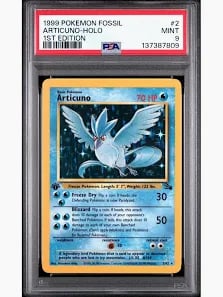
| 9 | Mint | Mint 9 | Near Mint/Mint |
| 8.5 | — | NM-Mint+ 8.5 | — |
| 8 | Near Mint-Mint | Near Mint-Mint 8 | Near Mint |
| 7 | Near Mint | Near Mint 7 | Fine/Very Fine |
| 6 | Excellent-Mint | Excellent-Mint 6 | Fine |
| 5 | Excellent | Excellent 5 | Very Good/Fine |
| 4 | Very Good-Excellent | VG-Excellent 4 | Very Good/Excellent |
| 3 | Very Good | Very Good 3 | Good/Very Good |
| 2 | Good | Good 2 | Good |
| 1 | Poor / Fair | Poor 1 | Poor |
BGS uses half-grades (9.5, 8.5, etc.) and is the only major agency to do so. PSA and CGC use whole numbers only. A BGS "Black Label 10" requires all four sub-grades to be a perfect 10.
Decoding the Perfect "Grade 10"
A Grade 10 represents the absolute pinnacle of card condition and preservation. However, not all 10s are equal in the card-collecting world. Depending on the agency, a perfect card is classified differently, each carrying its own distinct standard and market premium.
The most liquid and recognized Grade 10. Allows slight centering tolerances (up to 60/40 front) if the overall eye appeal is flawless.
Awarded only if all four sub-grades (Centering, Corners, Edges, Surface) are a perfect 10, requiring absolute 50/50 centering.
A flawless card under 10x magnification. Centering must be 50/50 with zero microscopic printing or cutting flaws allowed.
Verified by optical AI measurement systems (score of 950-1000). Removes human subjectivity, ensuring microscopic accuracy.
The Four Pillars of a Grade 10 Card
To submit cards with confidence, inspect these aspects using a jeweler's loupe and a centering tool under bright LED light.
Top 6 Professional Grading Agencies
Compare every major card grading brand currently active globally. Discover what sets each apart, what collectibles they grade, and access their official portals.
PSA (Professional Sports Authenticator)
United States (Global)The absolute market leader in sports and trading cards. PSA grading holds the highest resale premium in the secondary market.
Beckett Grading Services (BGS)
United States (Global)Renowned for thick, ultra-protective cases and precise sub-grades (Centering, Corners, Edges, Surface). A BGS Black Label 10 is the ultimate holy grail.
CGC Cards
United States (Global)Part of the giant Certified Guaranty Company. Known for crystal-clear labels, optical scanning, and being the definitive leader in grading misprints, errors, and comics.
SGC (Sportscard Guaranty Corp)
United StatesFamed for its custom black insert border, affectionately called the 'Tuxedo Slab.' Offers incredibly fast turnarounds and premium aesthetic fits.
TAG Grading (Technical Authentication Group)
United StatesFeatures transparent crystal-clear slabs with laser engraving. Grading is fully automated by optical AI cameras, providing detailed digital defect maps.
ACE Grading
United KingdomUK's premier grading agency. Gained worldwide acclaim for Ace Labels—custom labels that extend the card's artwork seamlessly to the borders.
Pricing & Turnaround Times
Approximate per-card costs and estimated turnaround times by service tier. Prices shift frequently — always verify on each agency's official submission page before you send cards.
Is It Worth Grading?
Grading is an investment. Before dropping $20–$150+ per card, run through these signals to determine if your submission makes financial sense.
Grade It ✓
- Card is Near Mint or better — high likelihood of a 9 or 10
- Raw value is $50+ — grading fee is a smaller percentage of the card's upside
- Card is a sought-after vintage or chase card (1st Edition, alternate art, star player rookie)
- A PSA 9 or 10 sells for 3× or more the raw price in eBay sold listings
- You want to long-term hold the card and protect it in a tamper-evident hard case
- Card has a print error or misprint you want authenticated (submit to CGC)
Skip It ✗
- Card is Lightly Played or worse — unlikely to hit a 9 regardless of agency
- Raw value under $20–30 — the grading fee will exceed the card's entire upside
- Card is common bulk — high supply means low collector demand for graded copies
- You need the money within 2–3 months — standard tiers have long wait times
- Graded PSA 10 comps on eBay show only a 1.5× or smaller premium above raw price
- Card is reprinted frequently — ongoing supply keeps the graded premium artificially low
Quick ROI Check
Search eBay's Sold Listings for the graded version of your card. If (Graded Sale Price) − (Grading Fee) > Raw Value, grading adds real money. Use our Vendor Pricing Calculator to estimate what your raw card is worth to a dealer first.
Pre-Submission Checklist
How you handle and package your cards before mailing is just as important as the card's original condition. Follow these steps every single submission.
Inspect Under Bright Light
Hold the card at multiple angles under a bright LED or phone flashlight. Look for surface scratches on holo foil, print lines, and silvering on corners and edges. A jeweler's loupe (10× magnification) is the gold standard tool for this.
Clean with a Dry Microfiber Cloth
Gently wipe fingerprints and dust using a clean, dry microfiber cloth. Handle cards by the edges only. Never use liquids, cleaning sprays, wax, or erasers — this will mark your card as Altered and destroy its value.
Sleeve in a Perfect Fit / Penny Sleeve
Slide the card into a snug perfect fit sleeve (also called a penny sleeve). This prevents the card from rattling inside the outer protection layer. Confirm the sleeve is dust-free before inserting.
Load into a Semi-Rigid or Top Loader
Place the sleeved card into a 55pt semi-rigid sleeve or standard 3×4 top loader. Semi-rigids are preferred by most agencies. Secure the opening with a small piece of painter's tape — never scotch tape directly on the sleeve or label.
Seal in a Team Bag
Place each top-loaded card into a resealable team bag. This provides moisture protection and keeps cards organized during transit. Group your cards in batches that match your submission invoice order.
Pack in a Rigid Box with Padding
Use a small, rigid cardboard box that fits your stack snugly. Fill any empty space with bubble wrap or packing foam so cards cannot shift. Avoid soft padded mailers — they offer zero crush protection and are a common cause of submission damage.
Ship with Tracking & Declared Value Insurance
Always ship using USPS Priority Mail, UPS, or FedEx with full tracking. Add declared value insurance equal to the total raw value of your submission. Keep your shipping receipt and tracking number safely until every graded card is back in your hands.
Ready to Submit? Pack Like a Pro
Don't let shipping damage ruin your perfect 10. Learn the industry-standard way to sleeve, semi-rigid load, and securely box your cards for their journey to the grading facility.
Buying Graded Cards: What to Look For
Not everyone submits their own cards — many collectors buy pre-graded slabs. Here's how to verify authenticity and avoid tampered or fake slabs before handing over your money.
Verify Slab Authenticity
- ✓Look up the cert number on the grading company's official website (PSA, BGS, and CGC all have free cert lookup tools). Confirm the card name, year, set, and grade all match what you're buying.
- ✓Scan the QR code or barcode on modern slabs with your phone to confirm it links directly to the official registry entry.
- ✓Inspect the label holographic security features under bright light. Official labels have fine micro-printing and rainbow holograms. Fakes look flat and slightly blurry.
- ✓Listen for a rattle — authentic sealed slabs are solid. If the card moves or shifts inside the case, it may have been cracked open and poorly re-glued.
Red Flags to Avoid
- ✗Seller refuses to share the cert number before purchase — this is an immediate deal-breaker.
- ✗Price is suspiciously below market comps — a PSA 10 Charizard priced 50%+ below eBay sold listings is almost certainly a counterfeit or tampered slab.
- ✗Visible gaps or seam damage along slab edges — the case has likely been cracked, the card swapped, and the case poorly resealed.
- ✗Label fonts, colors, or layout look off — compare side-by-side with confirmed authentic slabs from the same company and time period.
Where to Buy Graded Cards
Find Graded Cards at Trading Card Shows
Card shows are one of the best places to buy and sell graded slabs — you can inspect the case, scan the cert number on the spot, and negotiate directly with vendors. Many dealers also offer free raw card evaluations to help you decide what's worth submitting before you pay grading fees.
Frequently Asked Questions
Turnaround times vary significantly by company and the service level you choose. Premium or expedited tiers can take a few days, while standard bulk submissions may take anywhere from 1 to 3 months depending on their current backlog.
It depends on the card's raw condition and intrinsic value. High-value vintage or pristine modern chase cards often see a massive price multiplier if they achieve a 9 or 10. However, cards in played condition or low-value modern bulk might not recover the upfront cost of the grading fees. You can use our Vendor Pricing Calculator to estimate what stores might offer for your raw cards before deciding to submit them for grading.
Sub-grades provide individual scores for the four pillars of grading: Centering, Corners, Edges, and Surface. Companies like BGS and CGC optionally offer them. They are fantastic for high-end cards to transparently prove why a card received its overall grade, though they usually incur an additional fee.
Yes, gently wiping the surface of holographic or foil cards with a clean, dry microfiber cloth to remove fingerprints and dust is highly recommended. Never use liquids, chemicals, or wax, as this will damage the cardboard and result in an "Altered" or rejected grade.
Crossgrading means cracking open a graded slab from one company and resubmitting the card to a different agency — usually to chase a higher numeric grade, move to a slab with a better resale premium (e.g., a BGS 9 cracked to attempt a PSA 10), or change the slab aesthetic. It comes with real risk: you pay grading fees again and there's no guarantee of a better grade. Only crossgrade when the target company's sold comps show a meaningful price premium that justifies the fee and risk.
If a grading company's authenticators determine a card has been chemically treated, trimmed, or artificially restored, they will return it ungraded and flag it as Authentic – Altered. This designation immediately and permanently destroys the card's resale value — any serious buyer will see it and walk away. Some ungradeable cards may simply come back as "Authentic" (genuine but non-gradeable). To avoid this, never use any liquids, chemicals, erasers, or abrasives on your cards at any time.
Pokémon: Vintage cards (Base Set 1st Edition, Shadowless, early Jungle/Fossil sets) command enormous premiums graded at PSA 9–10. Modern chase cards — alternate arts, special illustration rares, gold secrets — can also be very profitable in NM+ raw condition. Bulk commons and uncommons are almost never worth grading.
Sports Cards: Rookie cards of active superstars and legend vintage cards (Jordan, LeBron, Mantle) are the sweet spot. Modern base cards of current stars in pristine condition can be lucrative when the population of PSA 10s remains low.
Magic: The Gathering: Vintage power cards (Black Lotus, Moxes, dual lands) and Reserved List staples grade extremely well. Most modern Magic cards see low graded premiums because the MTG collector base historically prioritizes playability over slabbed condition — though this is slowly changing with collectors entering the market.
Beyond eBay, you can find graded cards on TCGPlayer (strong TCG inventory with built-in buyer protection), PWCC Marketplace (weekly and premier auctions for high-end slabs), Goldin Auctions (premium sports and Pokémon collectibles), and MySlabs (a dedicated graded-card marketplace with built-in cert verification). You can also find graded cards directly at trading card shows — arguably the best option since you can physically inspect the slab, verify the cert number on the spot, and negotiate face-to-face with the vendor.